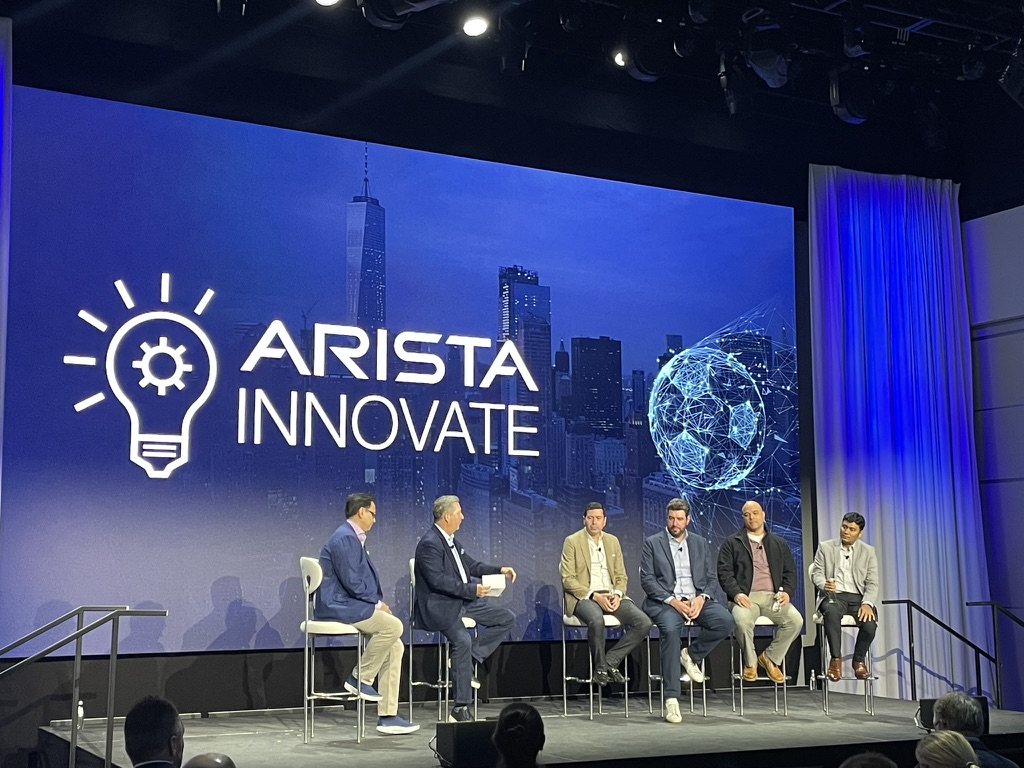
Last Wednesday I was in Midtown for Arista Innovate NYC. The event ran a full day: morning demos and sponsor booths, afternoon breakout sessions across five tracks, and woven throughout, a series of customer conversations. I was part of a Fireside Chat with VIP Customers hosted by Ashwin Kohli, Chief Customer Officer, and Christopher Schmidt, Chief Sales Officer at Arista.
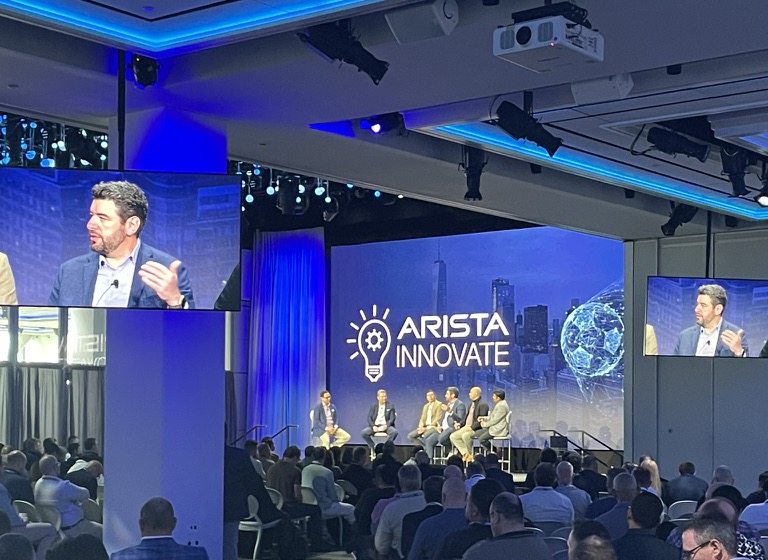
The other panelists were peers from Millennium, H-E-B, and S&P Global.
No slides, no script. Just a conversation in front of the room.
The cross-section of industries on that panel was worth noting on its own. A multi-strategy hedge fund, one of the largest privately-held grocery retailers in the country, a financial data and analytics platform, and a media and entertainment company. Four organizations that look nothing alike on the surface, with fundamentally different business models, user bases, and regulatory environments. And yet the conversation that followed could have been about any of us. The same themes kept surfacing: complexity that outpaces the operations model, automation that depends on a clean foundation, observability as the prerequisite for everything else. The problems of running a modern enterprise network have converged in ways that would have been harder to see even five years ago.
The Morning: Themes on the Floor
The demo area in the morning set up the recurring threads for the rest of the day. Four product areas were featured: observability for next-generation networks, network CI/CD with Arista AVD and CloudVision, EVPN for the enterprise, and campus networking. Looking at that list, the organizing principle is pretty clear. Arista is pushing the idea that the network should be manageable as code, testable before it ships, and visible once it’s running.
The AVD and CloudVision demo in particular reflects something I’ve been thinking about for a while. Validated design frameworks and pipeline-driven deployment aren’t just efficiency plays. They’re a forcing function for the standardization that makes everything else possible. You can’t automate what you haven’t defined. You can’t observe what you haven’t instrumented. That sequence matters.
On the Fireside Chat
The afternoon breakout tracks covered modern data center design, campus networking, AI front-end and back-end networks, enterprise routing architectures, and observability. The fact that observability got its own session, alongside the more infrastructure-focused tracks, says something about where the conversation in the industry has moved. It’s no longer framed as a monitoring problem. It’s framed as an operational discipline.
That framing matches what Ashwin and Christopher asked about in the fireside chat. The questions were honest and direct, and the format let the conversation go deeper than a typical panel.
One of the first topics was how we think about the network’s role in supporting business outcomes, not just technical requirements. My answer was grounded in the reality of what SiriusXM actually needs: 170 million monthly listeners across a mix of live, on-demand, and curated programming. The network has to work everywhere at once, and it has to be observable enough that when something goes wrong, we can get to root cause fast. Seamless connectivity is an assumption now, not a feature.
On Observability as Infrastructure
The thread I kept returning to was that visibility is the prerequisite, not the goal. You can invest in automation, adopt AI-assisted workflows, standardize your configurations. But if the network can’t explain what it’s doing in real time, you’re still guessing when things break. And guessing has a cost.
The shift we’ve made is treating telemetry as infrastructure: designed in, not bolted on. The network should be able to explain itself. What it’s doing, what changed, why a path looks different than it did an hour ago. That’s a higher bar than most environments were built to meet, but it’s the bar worth working toward.
The observability track at the event reflects the same thinking. The tooling has matured to the point where the bottleneck isn’t collecting data anymore. It’s deciding what to do with it and making sure the team knows how to use it.
On Automation and the Foundation Problem
Another thread in the conversation was where automation is actually delivering value versus where it’s still aspirational.
My honest answer: the value shows up first in the operational layer. Not in “the network configures itself” moments, but in shorter cycles between intent and running change. Faster validation, faster rollback, fewer manual steps. When those cycles compress, the team operates differently.
But automation follows standardization. If the underlying environment is inconsistent, automating it just moves the complexity around. The discipline of getting the foundation right, consistent configs, consistent policies, a clean automation surface, has to come first. AVD and CloudVision are interesting precisely because they’re opinionated about that foundation. That kind of opinionation is useful when you’re trying to scale.
On AI-Ready Networks
The breakout on AI front-end and back-end networks is the track I found most forward-looking, for obvious reasons. Everyone is trying to figure out what “AI-ready network” actually means in practice.
My view is that AI workloads expose weaknesses in the network that other workloads tolerate. The throughput requirements, the east-west traffic patterns, the sensitivity to congestion in GPU clusters: these aren’t just more of the same. They’re a different problem class. And the networks that handle them well will have been designed with that in mind from the start, not retrofitted.
The same principle applies to AI-assisted network engineering, which is the other side of the conversation. The network has to expose clean APIs and consistent state to be useful to AI tooling. A closed, inconsistent environment isn’t made better by pointing a language model at it. The foundation still matters.
The One-Liner
The fireside format ended the way these things tend to end: a final question to each participant. Mine was about what I’d tell peers who are early in modernizing their infrastructure.
My answer: start with the foundation, build observability in, and don’t automate inconsistency. The tooling available now is genuinely good. But it’s only as useful as the environment it runs in.
Good day. The breakout format gave the room options, and the fireside format gave the conversation room to breathe. The best events are the ones where you leave with more to think about than when you arrived.